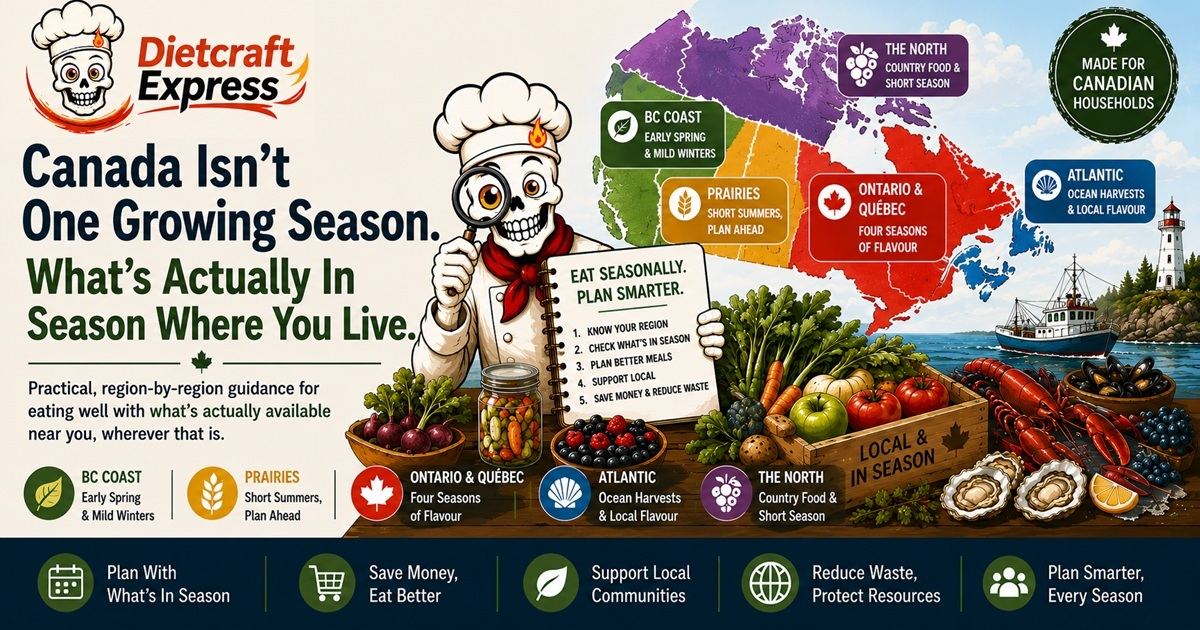
Most “what’s in season” guides picture the same thing: a farmers market somewhere in southern Ontario, tomatoes piled high in August, apples arriving in October. That’s a real picture. It’s just only one province’s picture. A fishing household on the Nova Scotia coast, a family in Regina restocking the freezer before winter, and someone in Whitehorse checking their garden in June are all living through completely different growing seasons at the same time of year, even though every one of them is in Canada.
One country, five growing regions
Most seasonal-eating advice treats the whole country like a single climate. It isn’t. Canada spans five genuinely different growing regions, and what counts as in season in one of them can be months away, or simply unavailable, in another. Coastal British Columbia gets spring a full season before the Prairies do. Atlantic Canada runs on tides and lobster openings as much as it runs on harvests. The North doesn’t fit the farm-to-table calendar at all. None of that is a technicality. It’s the actual shape of the country, and a seasonal guide that ignores it isn’t really describing Canada.
What’s actually in season, coast to coast
On the West Coast, spring shows up early and generous. Spot prawns and asparagus lead the way, followed by a summer of berries, stone fruit, and salmon. Autumn brings wild mushrooms and Dungeness crab, and even winter isn’t bare here. Oysters and hardy greens carry through the colder months, and the climate is mild enough that some local produce sticks around all year.
Alberta, Saskatchewan, and Manitoba work on a different rhythm entirely: short, intense summers and long winters that reward planning ahead. Saskatoon berries are the region’s signature crop, alongside pulses, legumes, and a real culture of preserving. Root cellars and canning aren’t nostalgia on the Prairies. They’re how a winter kitchen actually runs, built on stored roots, grains, and whatever got put up in August.
Ontario and Québec get the four-season version most people picture when they hear “seasonal eating.” Fiddleheads and the tail end of maple season in spring. A summer explosion of corn and tender fruit. An autumn built around apples and squash. A winter that leans on storage crops with some greenhouse help filling in the gaps. It’s a real season, just not the only one the country has.
Out east, the calendar runs on seafood as much as produce. Fiddleheads mark spring here too, and the opening of lobster season is treated less like a harvest date and more like a regional event. Summer means wild blueberries. Autumn brings Digby scallops, PEI potatoes, and cranberries. Winter’s freshest option is often still the ocean, with oysters at their best. Newfoundland has the shortest, latest growing season in the country, and a supply chain that depends on ferries, which shapes what’s realistic to plan around more than any calendar does.
The North needs a different kind of honesty than the rest of this list. A lot of what’s eaten in the Yukon, the Northwest Territories, and Nunavut is shipped in, and pretending otherwise wouldn’t be fair to anyone living there. But country food, Arctic char, caribou, and a short, precious window of cloudberries and crowberries in late summer, is food that communities have relied on and cared for long before any grocery flyer existed, not a seasonal curiosity, and it looks different from one community to the next. The Yukon has real garden and greenhouse growing; Nunavut has almost none. Any seasonal guide that treats the North as an afterthought isn’t really being honest about the country it’s describing.
Seasonal doesn’t mean harvested this morning
Worth being clear about what a guide like this can actually promise. It isn’t a live crop tracker, and nobody can honestly claim to know what’s growing in your specific backyard on a given Tuesday. What it can offer is the traditional pattern: what a region has reliably grown, fished, or foraged at a given time of year, grounded in real provincial agricultural sources instead of a guess. That’s a smaller claim than “fresh today.” It also happens to be a more honest one, and honesty tends to age better than a promise nobody could actually keep.
How to actually use this
Let the season do some of the deciding instead of fighting it. Check the flyer before deciding what the week looks like, the same way planning around what’s already on sale saves money in the first place. In summer, that usually means corn, berries, and whatever’s overflowing at the market. In winter, it means leaning into root vegetables and storage crops instead of paying extra for something flown in from somewhere warm. A planning tool that already knows which of these regions you’re shopping in, and what season it actually is there, can build that into the week without you having to think about it.
None of this requires memorizing five growing regions. It just means treating what’s actually available near you right now as a real starting point instead of an afterthought, which turns out to matter more for a country this size than most seasonal advice gives it credit for.
A plan built around your region and your season
Dietcraft Express knows which growing region you’re shopping in and what’s in season there right now — free, no account needed.
Try the free planner →